


Chief Data and AI Officer Program
Invalid liquid data
Invalid liquid data
Chief Data and AI Officer Program: Lead AI Strategy and Enterprise Transformation
The Chief Data and AI Officer (CDAIO) Program, offered by Michigan Ross Executive Education and Michigan Engineering Professional Education, is a five-month executive education program designed for senior executives leading AI-driven initiatives, data strategy, and digital transformation efforts across their organizations.
The program combines self-paced online learning, live online sessions, business case simulations, company and executive discussions, a capstone initiative, and a five-day on-campus immersion at the University of Michigan campus in Ann Arbor, Michigan. Participants develop capabilities across data strategy, AI and analytics applications, governance, and business value creation while strengthening the leadership skills required to drive AI adoption and enterprise-wide transformation.
About Michigan Ross Executive Education and Michigan Engineering Professional Education
Michigan Engineering Professional Education is a global leader in interdisciplinary research and innovation, equipping leaders in engineering with the technical expertise and forward-thinking mindset to solve the world’s most pressing challenges.
This program brings together the academic strengths of Ross Executive Education and Michigan Engineering Professional Education, offering a unique opportunity to learn at the intersection of business leadership and technological innovation. Participants benefit from the combined expertise of two top-ranked schools within a globally respected university.
#1
#11
350,000+
What Will You Learn in The Chief Data and AI Officer Program?
Key Takeaways
Today’s AI advantage is built on clear strategy, strong foundations, and the ability to scale execution across the enterprise. The program equips you with the leadership capabilities to translate AI investments into measurable outcomes while strengthening trust, governance, and long-term impact.
Proposed content for LOs:
Data strategy: Develop and implement data strategies aligned with your business objectives and ensure governance compliance and consistent data management across all functions.
AI adoption and innovation: Integrate AI solutions within strategic decision-making processes to fuel innovation, accelerate growth, and create a competitive advantage.
Data-driven decision-making: Make data-driven strategic decisions by analyzing customer demand, competition, and market trends to optimize business outcomes.
Governance and compliance: Ensure data security and compliance while extracting actionable insights through advanced analytics to support business objectives and maintain regulatory standards.
AI leadership and transformation: Lead AI-driven initiatives and manage digital transformation, equipping your organization to thrive in a dynamic and rapidly evolving business environment.
Emerging technologies: Leverage generative AI and other emerging technologies to enhance operational efficiency, streamline business processes, and guide strategic decision-making.
Learning Journey for the Chief Data and AI Officer Program
The five-month learning journey follows this structure:
Self-Paced Online Modules: Develop capabilities across data strategy, AI and analytics applications, trusted AI systems, governance, and business value creation.
Live Online Sessions: Participate in interactive faculty-led sessions covering enterprise AI leadership, data strategy, AI implementation, governance, and organizational transformation.
Business Case Simulations: Apply concepts through simulations designed around real enterprise AI and data leadership challenges.
Company and Executive Discussions: Explore leading technology organizations and innovation ecosystems through virtual visits and discussions on fireside chats.
Capstone Project: Develop a capstone initiative grounded in your organization that translates program concepts into an actionable implementation road map.
Five-Day On-Campus Immersion: Participate in immersive workshops, networking experiences, and applied learning sessions at the University of Michigan campus in Ann Arbor, Michigan.
How is the Chief Data and AI Officer Program Curriculum Structured?
Program Curriculum
Program Introduction and Orientation | Online and Live Online
Online access to Canvas and pre-program materials
Faculty-led program orientation
Pillar 1 — Foundations of Value Creation: Building Data-Driven Advantage | Faculty + Practitioner Sessions | 3 Live Online Sessions
In this pillar, you build a business-level understanding of how modern AI works, including machine learning (ML), neural networks, and generative AI. You then shift focus to the data foundations required to enable AI, including data strategy and data architecture decisions that support scalable, value-creating use cases.
• Explore foundational concepts in ML, basic models, training processes, and learning representations
• Examine the critical role of pretraining, transfer learning, and foundation models
• Develop data strategies that align with business objectives and opportunities
• Build robust and accessible data architectures that enable business insights
Pillar 2 — Creating Value to Win: AI for Business Impact | Faculty + Practitioner Sessions | 3 Live Online Sessions
In this pillar, you shift from AI foundations to business impact, focusing on how organizations align AI initiatives with business strategy and translate them into competitive advantage. You explore how AI creates measurable value through improved decision-making, efficiency, customer engagement, and innovation across industries and organizational contexts.
• Explore foundational strategy concepts, and discover how organizations sustain competitive advantage
• Understand how AI enhances efficiency, quality, and speed to create a competitive advantage
• Discover how AI enhances customer engagement, product innovation, and revenue growth
• Gain insights into AI-driven organizational design, decision-making, and internal coordination
Pillar 3 — Protecting and Preserving Value: Trusted AI — Securing Data and Scaling Analytics | Faculty + Practitioner Sessions | 2 Live Online Sessions
Through this pillar, you focus on protecting and sustaining the value created through AI by strengthening trust, compliance, and security. You explore how organizations design resilient data and AI systems, manage risk and breach response, and apply responsible AI principles to preserve long-term value.
• Build compliant, high-integrity systems aligned with evolving regulations, including GDPR, CCPA, and HIPAA
• Secure sensitive data with advanced tools, including encryption, anonymization, and emerging technologies
• Implement proactive risk management to prevent and respond to data breaches effectively
• Adopt responsible AI strategies that address bias, fairness, privacy, and transparency
Pillar 4 — Creating a Winning Strategy with AI | 5-Day On-Campus Immersion in Ann Arbor, Michigan
Through this pillar, you conclude the program with a highly immersive five-day on-campus experience focused on applying everything learned. You work through real organizational challenges, refine your AI-enabled initiative, and strengthen leadership confidence so you leave with a clear, practical plan to implement AI in your organization.
• Learn to adapt to changing consumer needs and business shifts with future technologies, including generative AI and autonomous AI systems, and their potential business impact.
• Create your own strategy and strategic narrative for your team, explicitly linking and aligning the strategy to your organization’s long-term competitive advantages
• Develop a comprehensive strategy for internal influence and leadership to break silos, create alliances, and drive your strategy forward
• Strengthen your persuasive communication and influencing skills while gaining practical tools to lead and manage organizational change effectively- specifically while driving AI and technology change initiatives
• Develop a personal leadership development plan to enhance your success and the success of your team
Note: Topics and schedule are subject to change.
Five-Day On-Campus Immersion
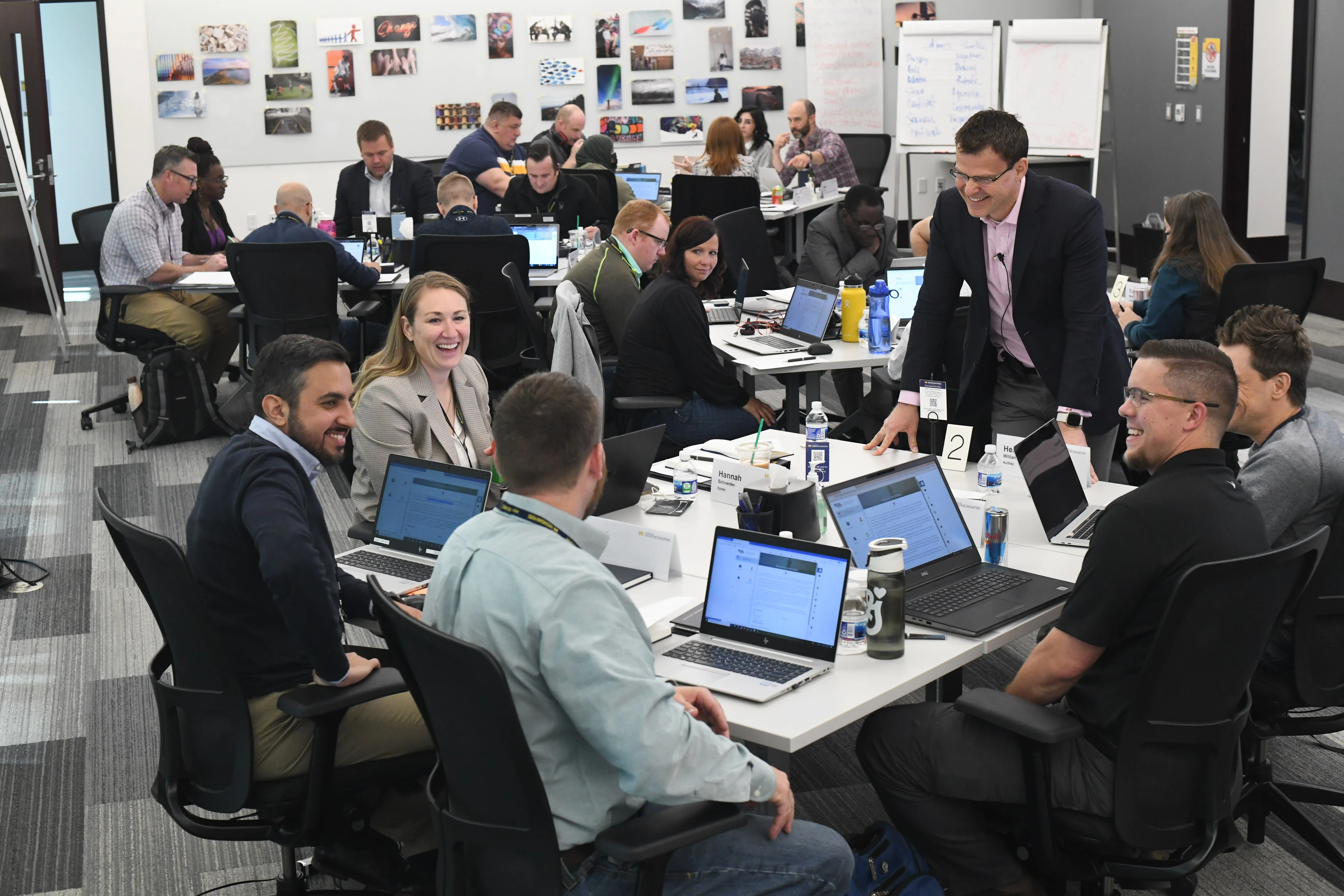
Designed to move beyond discussion into real application, the on-campus experience places you inside the Michigan innovation ecosystem and brings you into direct contact with faculty, alumni, industry leaders, and a high-caliber peer group. You will leave with stronger leadership confidence, sharper direction, and a clearer plan for what comes next inside your organization.
Company and Executive Discussions

Gain firsthand exposure to how leading organizations approach AI-driven strategy and innovation.
Live Academic Sessions

Engage in faculty-led sessions built for executive-level decisions in data, AI, and strategy.
Peer Networking

Build connections with senior leaders across industries and learn through shared enterprise experiences.
Capstone project
The capstone learning experience is designed to help you translate the program’s core ideas on strategy, value creation, and AI into a clear initiative relevant to your organization. You develop a capstone statement that connects an AI initiative to results and the competitive advantage it is intended to strengthen.
Through the capstone, you will:
Choose an AI initiative pathway: use case, infrastructure, or capacity
Build the “Why” framing: execution, results, and competitive advantage
Develop the capstone statement: initiative, measures, and performance impact
Use the CDAIO AI Strategy Canvas to shape strategic and execution requirements
How Does the CDAIO Program Use Applied Learning?
Live online sessions

Engage in interactive, faculty-led sessions that bring the University of Michigan classroom to you in real time. Learn alongside a global peer group as you explore how leading organizations build AI strategy, prioritize use cases, strengthen decision-making, and scale adoption across functions.
Five-Day On-Campus Immersion
Join a five-day in-person experience at the University of Michigan campus in Ann Arbor, Michigan, Michigan. Participate in hands-on workshops, business simulations, and immersive learning that help you sharpen executive presence, build internal influence, and connect with faculty, alumni, and the broader Michigan innovation ecosystem.
Capstone

Translate insights into action through a capstone project focused on a real AI leadership challenge in your organization. With faculty guidance, you will develop a strategic roadmap and narrative that connects AI initiatives to outcomes, competitive advantage, and sustained impact.
Program calendar
Date | Time | ||
|---|---|---|---|
Orientation session |
| December 1, 2026 | |
Online Session | Past, Present, and Future of AI (Part 1) | Self-paced | Self-paced |
Live Online Session | Past, Present, and Future of AI (Part 2) | December 3, 2026 | 11 a.m.-1:00 p.m. ET |
Live Online Session | Business Strategy and AI Advantage | December 10, 2026 | 11 a.m.-1:00 p.m. ET |
Live Online Session | Data Strategy for Strategic Success | December 17, 2026 | 11 a.m.-1:00 p.m. ET |
Live Online Session | Managing and Building a Robust Data Architecture | January 12, 2027 | 11 a.m.-1:00 p.m. ET |
Live Online Session | Leveraging AI for Business Success (Part 1) | January 28, 2027 | 11 a.m.-1:00 p.m. ET |
Online Session | Leveraging AI for Business Success (Part 2) | Self-paced | Self-paced |
Live Online Session | Creating a Trusted and High-Integrity System | February 11, 2027 | 11 a.m.-1:00 p.m. ET |
Live Online Session | Getting Ahead of Risk | February 25, 2027 | 11 a.m.-1:00 p.m. ET |
Live Online Session | Ethical AI Development and Application | March 4, 2027 | 11 a.m.-1:00 p.m. ET |
Online Session | Who Owns AI? Decision-rights and Value Creation in AI Strategy and Deployment | Self-paced | Self-paced |
On-campus sessions |
| March 8-12, 2027 |
|
Note: Session dates and timings are subject to change. Asynchronous sessions include curated readings, recorded lectures, and discussion board engagement.
Why Choose the CDAIO Program?
Program Focus | The CDAIO Program | Other AI Learning Formats |
Leadership Perspective | ✅ Enterprise leadership across AI, data, and strategy | ❌ Technical, analytical, or functional AI depth |
Learning Approach | ✅ Faculty-led live online sessions and in-person immersion | ❌ Often self-paced, function-specific learning |
Application Context | ✅ Capstone initiative aligned to your organization | ❌ Predefined use cases, simulations, or technical exercises |
Program Structure | ✅ End-to-end coverage: create, scale, protect value | ❌ Often modular; focused on exposure or skill acquisition |
Action Orientation | ✅ Strategic playbooks, immediate application | ❌ Technical or theory focused |
Value Proposition | ✅ Practical, business-first mindset for leaders who need results | ❌ Credential-led, skill-led, or theory-heavy positioning |
Networking Opportunities | ✅ Five-day on-campus immersion; ecosystem exposure and executive connections | ❌ Virtual peer exchanges; fewer in-person opportunities |
Peer Engagement | ✅ Cross-industry cohort learning and perspective exchange | ❌ Peer interaction varies by format; often limited to forums |
Program highlights

On-campus immersion
Step into a five-day on-campus immersion featuring hands-on learning, business simulations, and ecosystem exposure, with direct access to faculty, industry experts, and peers.

Live online sessions
Join interactive live online sessions with faculty, along with periodic guest lectures from industry leaders, focused on real enterprise AI decisions and trade-offs.

Comprehensive curriculum
Build end-to-end capability across AI foundations, value creation, governance, and enterprise execution through a structured curriculum.

Expert faculty
Gain insights from top faculty, thought leaders, and industry experts in data, AI, and business strategy who are actively shaping emerging technologies.

Company and executive discussions
Experience company and executive discussions through virtual visits with leading tech companies, and see how AI strategy translates into operating realities.

Business case simulations
Work through business case simulations that mirror real organizational challenges, strengthening strategic decision-making and execution readiness.

AI innovation and insights
Gain exposure to emerging AI developments through experts in the field, including researchers from Michigan AI.

Capstone project
Develop a capstone initiative grounded in your organization, translating program learning into a clear strategy, narrative, and road map.

Networking opportunities
Benchmark approaches and exchange playbooks with high-achieving executives across industries through peer networking.
Meet the Faculty of the CDAIO Program

Brad Killaly, PhD
Faculty Director for the CDAIO Program; Clinical Associate Professor of Strategy, Ross School of Business, University of Michigan
Brad’s research focuses on healthcare, studying how policies, labor turnover, and growth strategies affect hospice and long-term care providers. Previously, he held faculty ro...

Jenna Wiens, PhD
Technical Faculty Advisor for the CDAIO Program; Associate Professor, Computer Science and Engineering, College of Engineering, University of Michigan
Recognized for her impactful contributions to science and technology, Professor Wiens was named to Forbes’ 30 Under 30 in Science and Healthcare in 2015 and MIT Technology Rev...

Hyun-Soo Ahn, PhD
Professor of Technology and Operations; Ford Motor Company Business Co-Director of the Joel D. Tauber Institute for Global Operations, Michigan Ross, University of Michigan
Hyun-soo Ahn’s research focuses on supply chain management, service operations, pricing strategies, and value chain innovation. A recipient of the 2019 Ross Researcher of the ...

Andrew Rosenberg, MD
Chief Information Officer, Michigan Medicine, University of Michigan
Dr. Andrew Rosenberg leads IT strategy and operations for Michigan Medicine and oversees the University of Michigan Health and the University of Michigan Medical School. Previ...

Mosharaf Chowdhury
Associate Professor of Computer Science and Engineering; Director of SymbioticLab, University of Michigan
Mosharaf Chowdhury specializes in large-scale systems for AI/ML and big data workloads, with a focus on cloud efficiency, federated learning, and energy optimization. His grou...

Eric Schwartz, PhD
Associate Professor of Marketing, Ross School of Business, University of Michigan
Professor Eric Schwartz's expertise focuses on predicting customer behavior, understanding its drivers, and examining how firms actively manage their customer relationships th...

Lindy Greer, PhD
Gerald and Esther Carey Professor of Business Administration; Professor of Management and Organizations, Ross School of Business, University of Michigan
Professor Lindy Greer’s research focuses on how to design and lead high-performing teams, with an emphasis on team dynamics, conflict, and leadership effectiveness. She has pu...

Norman Bishara, JD, MPP
Professor of Business Law and Ethics, Stephen M. Ross School of Business, University of Michigan
Norman Bishara’s research focuses on corporate governance, business ethics, and human capital law, including employee noncompete agreements, labor mobility, and the Future of ...

Christopher Rider, PhD
Thomas C. Kinnear Professor and Associate Professor of Entrepreneurial Studies, Stephen M. Ross School of Business, University of Michigan

Monica Worline, PhD
Faculty Director, Center for Positive Organizations; Lecturer of Management and Organizations, Stephen M. Ross School of Business, University of Michigan

Michael Hess
Chief Information Officer, Adjunct Lecturer in Information, Research Computer Specialist, School of Information and Application Programmer/Analyst, Family Medicine, Medical School

Sarah Zimmerman
Lecturer of Business Communication, Michigan Ross, University of Michigan

John Thompson
Industry Expert; Intermittent Lecturer in Information, University of Michigan School of Information; UMSI Advisory Board Member

Maxim Sytch
Jack D. Sparks Whirlpool Corporation Research Professor of Business Administration; Professor of Management and Organizations, Michigan Ross, University of Michigan

Ravi Pendse, Ph.D
Vice President for Information Technology and Chief Information Officer, University of Michigan
Hear From the Faculty of the CDAIO Program
Hear from past participants of the CDAIO Program


Who is the CDAIO Program for?
Current CDAOs and CDAIOs | Strengthen enterprise AI leadership capabilities and scale AI initiatives across the organization. |
Chief Digital Officers and Chief Technology Officers | Connect AI strategy with enterprise transformation priorities and business outcomes. |
Data, Analytics, and AI Leaders | Develop frameworks for governance, implementation, and value creation. |
Senior Business Leaders Responsible for AI Adoption | Build confidence in leading enterprise AI initiatives and organizational change. |
Executives Leading Digital Transformation | Strengthen leadership capabilities for AI-enabled business transformation. |
What Credentials and Outcomes Will You Gain from the Chief Data and AI Officer Program?
Certificate
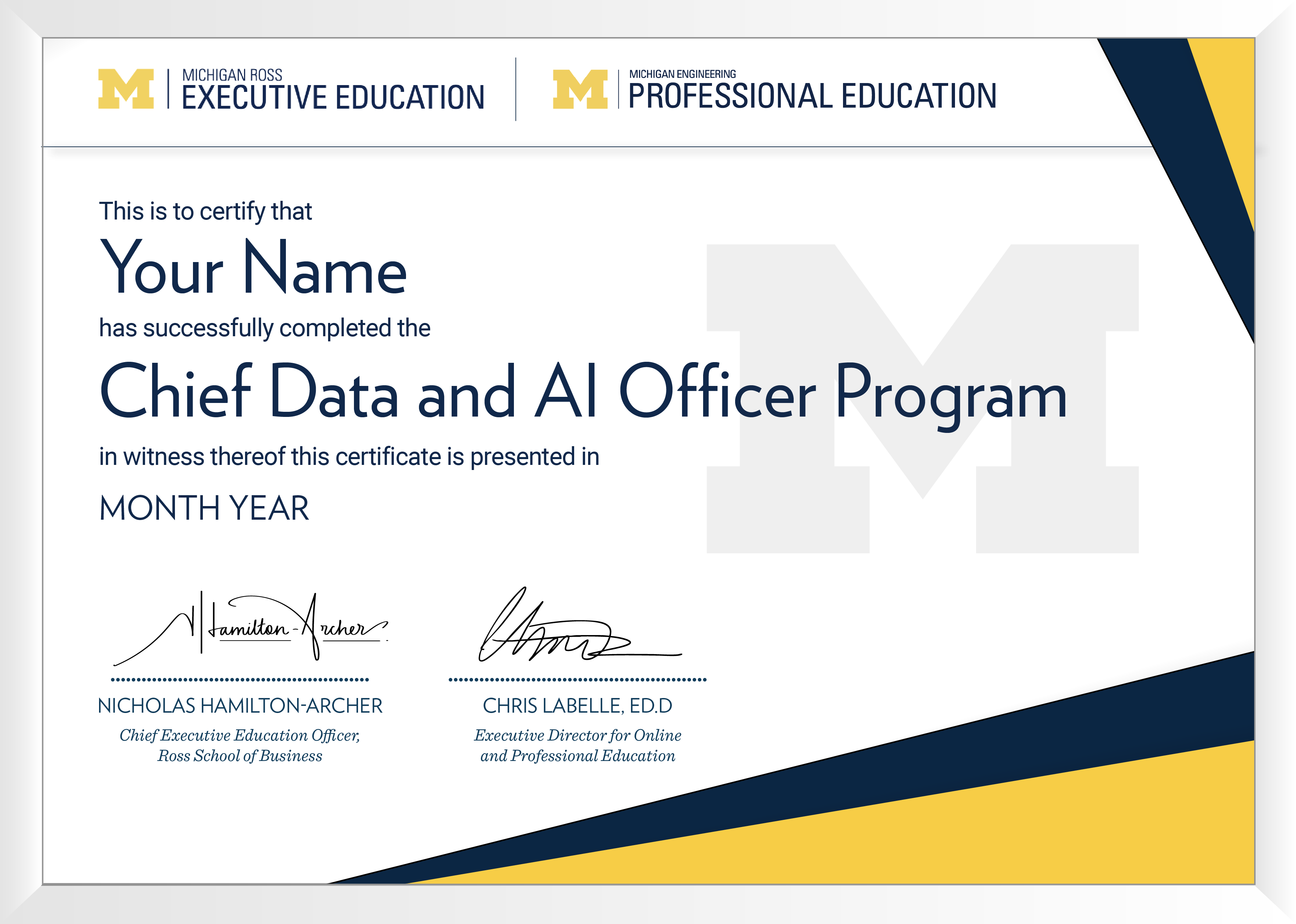
Upon successful completion of the program, participants will be awarded a verified digital certificate by Michigan Ross Executive Education and Michigan Engineering Professional Education. The certificate will be a recognition of their achievement in the Chief Data and AI Officer Program.
To meet the completion requirements for this program and receive a certificate, participants are expected to:
Attend at least seven of eight live online sessions
Complete three asynchronous modules
Fully participate in the on-campus component
Participants are expected to be present for the entirety of the on-campus residency. If they are unable to attend any part of the residency, we recommend delaying their application until a future cohort.
Note: After successful completion of the program, your verified digital certificate will be emailed to you in the name you used when registering for the program. All certificate images are for illustrative purposes only and may be subject to change at the discretion of Michigan Ross Executive Education and Michigan Engineering Professional Education.

Earn credentials
Upon successfully completing the program:
Receive a digital badge to showcase on LinkedIn and other social media platforms
Earn 8 credits toward the Distinguished Leader Certificate (DLC) which requires a total of 14 credits from qualifying in-person or online programs
Exclusive Program Fee Benefit for U-M Alumni
Graduates of the University of Michigan — including the Ann Arbor, Dearborn, or Flint campuses — are eligible for a 15% reduction on the program fee for the Michigan Ross Executive Education Emeritus partner programs.
Note: This alumni benefit cannot be combined with other promotional offers and is subject to change at the discretion of the university or school.
FAQs
The Program
1. What is the Chief Data and AI Officer Program?
The Chief Data and AI Officer Program is a five-month executive education program offered by Michigan Ross Executive Education and Michigan Engineering Professional Education. The program equips senior executives with the frameworks, leadership capabilities, and practical tools required to lead AI-driven initiatives, deliver data-driven strategies, and drive digital transformation across their organizations.
2. Who is the CDAIO Program designed for?
The CDAIO Program is ideal for C-suite and senior leaders driving AI and digital strategy such as CDOs, CTOs, CIOs, and AI-focused executives—who seek to harness emerging technologies for business growth.
It is especially relevant for:
AI leaders aiming to scale innovation and gain a competitive edge
Data and analytics heads looking to apply AI for strategic decision-making
Digital leaders and entrepreneurs focused on driving tech-enabled transformation
3. What will I learn in the Chief Data and AI Officer Program from Michigan Engineering Professional Education?
Participants develop capabilities across data management and strategy, AI and analytics applications, and business strategy and value creation — the three dimensions critical to successful CDAIO leadership. The program explores how organizations can scale AI initiatives, strengthen strategic decision-making, and translate AI investments into measurable business outcomes.
4. How is the Chief Data and AI Officer Program structured?
The five-month program combines self-paced online learning, live online sessions, business case simulations, company and executive discussions, a capstone initiative, and a five-day on-campus immersion at the University of Michigan campus in Ann Arbor, Michigan,
5. Does the Chief Data and AI Officer Program cover generative AI and emerging technologies?
Yes. The program explores emerging technologies, including generative AI, and their implications for business strategy, innovation, AI adoption, and organizational transformation.
6. How does the Chief Data and AI Officer Program help leaders build AI strategy capabilities?
The program helps participants develop frameworks to identify AI opportunities, prioritize use cases, strengthen governance, and align AI initiatives with organizational objectives and measurable business value.
7. How does the Chief Data and AI Officer Program support AI leadership?
Participants explore how to lead AI-driven initiatives across functions, strengthen organizational readiness, establish governance frameworks, and translate AI investments into long-term business impact.
8. How do business case simulations support learning in the CDAIO Program?
Business case simulations allow participants to apply program frameworks to real organizational challenges involving AI adoption, governance, strategic prioritization, and business transformation.
9. What is the capstone initiative in the Chief Data and AI Officer Program?
The capstone initiative gives participants an opportunity to apply program concepts to a real AI leadership challenge within their own organization. Participants develop a strategic roadmap and narrative that connect AI initiatives to business outcomes, competitive advantage, and sustained impact.
10. How do company and executive discussions support learning in the CDAIO Program?
Company and executive discussions provide participants with exposure to how leading organizations approach AI-driven strategy, innovation, and business transformation through virtual and in-person visits and discussions with industry leaders.
11. How does the Chief Data and AI Officer Program help organizations create business value with AI?
Participants explore approaches for connecting AI initiatives to business priorities, operational outcomes, customer value, and long-term competitive advantage while strengthening governance and organizational readiness.
12. How does the Chief Data and AI Officer Program approach AI governance and trusted adoption?
The program examines the governance, compliance, and organizational considerations required for responsible AI adoption, helping leaders strengthen trust, governance, and long-term impact across AI initiatives.
13. What AI leadership capabilities will participants develop in the Chief Data and AI Officer Program?
Participants strengthen capabilities across:
AI strategy and implementation
Data-driven decision-making
AI governance and responsible adoption
Cross-functional leadership and alignment
Organizational transformation and change management
Business value creation through AI initiatives
14. What types of business challenges does the Chief Data and AI Officer Program address?
The Chief Data and AI Officer Program explores practical challenges, including:
Scaling AI initiatives across the enterprise
Aligning AI investments with business objectives
Establishing governance and compliance frameworks
Driving digital transformation initiatives
Building organizational readiness for AI adoption
Translating AI investments into measurable business outcomes
15. How does the Chief Data and AI Officer Program prepare leaders for enterprise AI adoption?
Participants in the Chief Data and AI Officer Program explore approaches for:
Identifying high-value AI opportunities
Prioritizing AI use cases across functions
Building governance frameworks for AI implementation
Strengthening trust and organizational buy-in
Managing AI-driven organizational change
Creating sustainable business value from AI investments
Learning journey
16. What is the expected weekly time commitment for the Chief Data and AI Officer Program?
Participants should expect to dedicate approximately three to five hours per week to self-paced online learning activities, live online sessions, assignments, and collaborative discussions throughout the five-month program, in addition to participation in the five-day on-campus immersion.
17. What can I expect from the five-day on-campus immersion?
The five-day on-campus immersion at the University of Michigan campus in Ann Arbor, Michigan, combines workshops, business simulations, faculty interaction, company engagement, and peer networking to strengthen leadership capabilities and practical application.
Admissions
How do I know if this program is right for me?
After reviewing the information on the program landing page, we encourage you to submit the short form above to access the program brochure, which offers detailed insights into how this program supports the evolving needs in AI for business leaders. If you’re still unsure whether this is the right fit for you, feel free to email learner.success@emeritus.org, and a dedicated program advisor will get in touch with you shortly.
Certificate
19. What credentials will I receive upon completing the Chief Data and AI Officer Program?
Upon successful completion of the program, participants receive a verified digital certificate from Michigan Ross Executive Education and Michigan Engineering Professional Education.
20. Does the Chief Data and AI Officer Program count toward the Distinguished Leader Certificate (DLC)?
Yes. Upon successful completion of the program, participants earn credits toward the Distinguished Leader Certificate, enabling them to continue building their executive learning journey across eligible Michigan Ross Executive Education offerings.
Payment process
21. Who will be collecting the payment for the program?
Emeritus collects all program payments, provides learner enrollment and program support, and manages learning platform services.
22. Are there any restrictions on the types of funding that can be used to pay for the program?
Program fees for Emeritus programs with Ross School of Business and Michigan Engineering Professional Education may not be paid for with (a) funds from the GI Bill, the Post-9/11 Educational Assistance Act of 2008, or similar types of military education funding benefits or (b) Title IV financial aid funds.
Refund policy
23. What is the refund and deferral policy for the Chief Data and AI Officer Program?
For the program refund and deferral policy, please click the link here.
Accessibility
How does Emeritus support accessibility for learners?
Emeritus is committed to making high-quality education accessible and affordable to individuals, companies, and governments around the world. If you have questions about accessibility or would like to discuss available support options before enrolling, please contact accessibility@emeritus.org. For more information about our accessibility practices, please review our Accessibility Policy here.
Connect with a Program Advisor for a 1:1 Session
Our program advisors have helped senior executives around the world choose the right program for their career goals. Schedule a 1:1 to get a deeper understanding why the Chief Data and AI Officer Program is the right fit for you.
Email: umic_cdaio@emeritus.org
Phone: +1 315 669 8096 (U.S.) +44 1277 674106 (U.K.) +971 80 0088601086 (U.A.E.) +52 55965 43507 (LATAM)
We encourage early application due to limited cohort capacity.
Flexible payment options available.
Starts On